![Signals From [Space]](https://substackcdn.com/image/fetch/$s_!IXc-!,w_120,h_120,c_fill,f_webp,q_auto:good,fl_progressive:steep/https%3A%2F%2Fsubstack-post-media.s3.amazonaws.com%2Fpublic%2Fimages%2F9f7142a0-6602-495d-ab65-0e4c98cc67d4_450x450.png)
![Signals From [Space]](https://substackcdn.com/image/fetch/$s_!lBsj!,e_trim:10:white/e_trim:10:transparent/h_48,c_limit,f_auto,q_auto:good,fl_progressive:steep/https%3A%2F%2Fsubstack-post-media.s3.amazonaws.com%2Fpublic%2Fimages%2F0e0f61bc-e3f5-4f03-9c6e-5ca5da1fa095_1848x352.png)
Finding My Voice in the New York Times
Why patient perspectives matter in the national conversation on organ donation
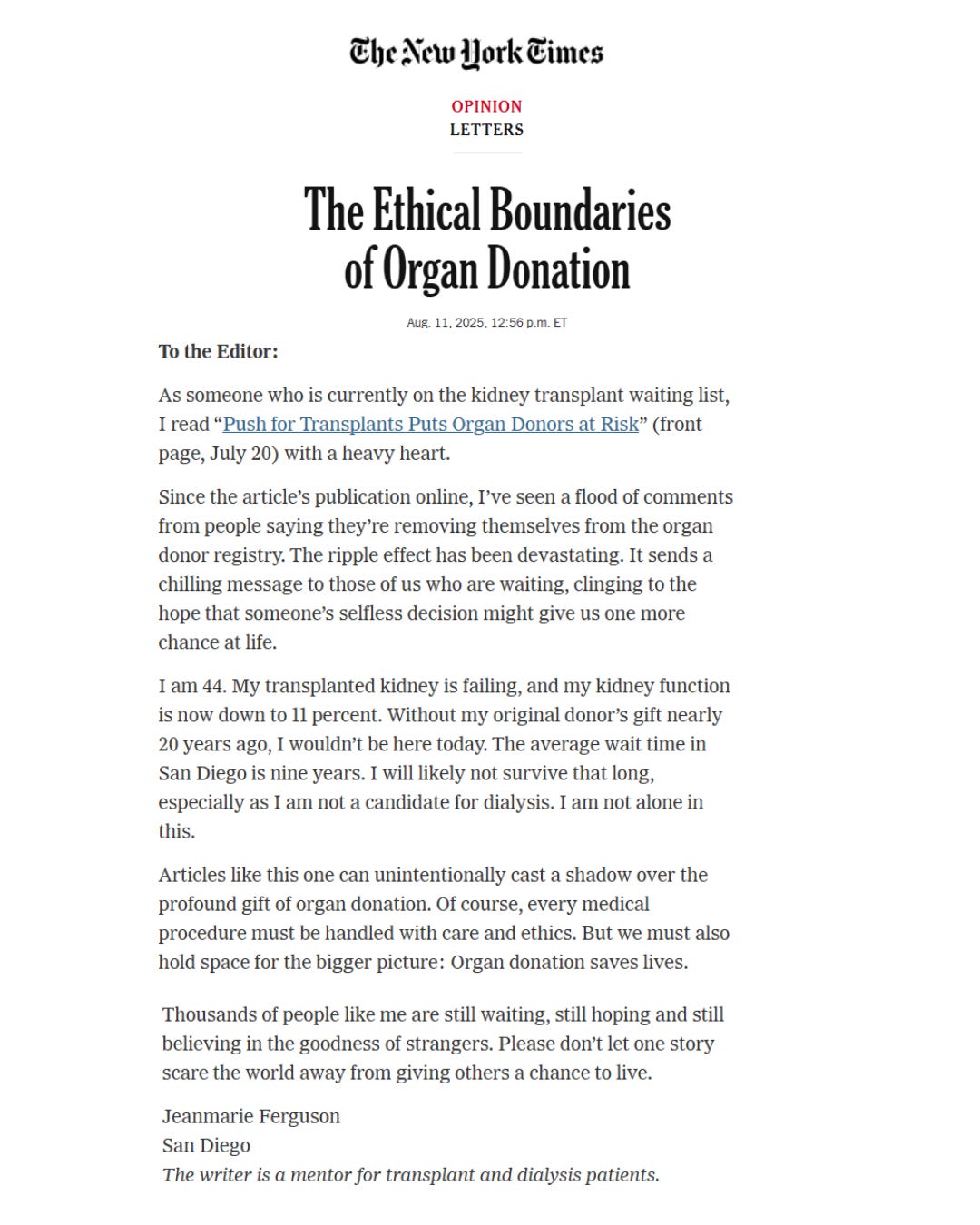
This guest post is part of our ongoing series spotlighting voices across kidney care. Today we’re featuring Jeanmarie Ferguson, a two-time kidney transplant recipient, peer mentor, and active advocate in the transplant community. Earlier this year, Jeanmarie wrote a response to a New York Times investigation on organ donation. Her letter was published a few weeks later, and not long after that, she got “the call” for a new kidney. In the post below, she reflects on why she spoke up, and how patient voices shape the national conversation on organ donation.

By Jeanmarie Ferguson
Recently, I had the unique experience of writing a letter to the editor in response to an article published in the New York Times. For me, it wasn’t just about reacting to what I read; it was about making sure that the voice of those waiting for a life-saving organ was represented in a national conversation.
When I began my advocacy journey, I wanted to learn as much as possible about the organ donation system and its inner workings. It seemed to be a complex web full of unknowns to many patients. After stepping into a role at TransplantLyfe, I still felt I could do more for patients. That led me to volunteer as a mentor for dialysis patients through ReMend at Balboa Nephrology. Those conversations raised even more questions about the waiting list and organ distribution, leading me to become a UNOS Ambassador. Still not satisfied, I also began volunteering with my local OPO (organ procurement organization). Through all of these roles, I learned so much about the donation process, and I can say with certainty, it is not at all like what was depicted in the New York Times article.
That is why I felt the urge to speak up.
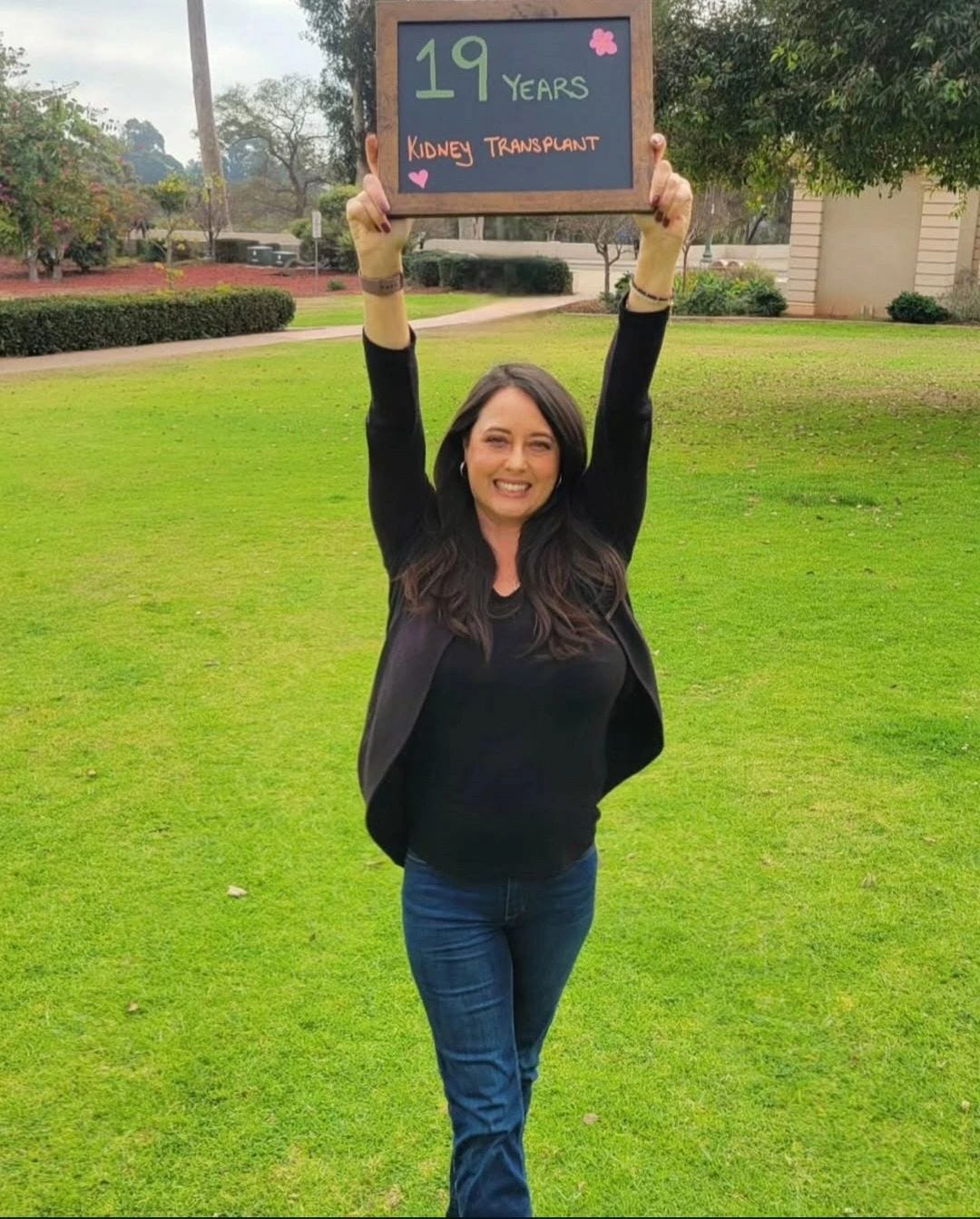
A surprising part of my journey has been seeing the transplant system from so many angles. I have navigated every corner of it for more than thirty years—as a long-term patient, an advocate, a dialysis mentor, and now someone who volunteers within the transplant community. Each perspective has revealed pieces of the process that most people never see. I’ve learned how much unseen work goes into saving a single life, how many tiny decisions and moving parts must align, and how often patients only glimpse a fraction of that effort.
The gaps have struck me too: the moments where communication falters, where patients feel unheard, or where policy doesn’t match reality. But the most compelling insights come from the people themselves—the coordinators fighting for every organ, the medical teams who never let up, the families making impossible decisions in their darkest hours, and the patients who hold on even when the odds say they shouldn’t. Seeing the system up close has changed how I understand transplantation, and how I understand the resilience and complexity of the people behind it.
I didn’t expect anyone to read my letter, let alone for it to be published. But after it appeared, I received an outpouring of messages from across the United States. People thanking me for sharing my perspective and for standing up for the truth about organ donation. Advocacy may not be for everyone, but I believe we can all support one another, especially those still waiting, by using our voices to remind the world of the importance of organ donation. I would not be here today without the generosity of my two donors, and it is their legacy that fuels my commitment to speak out.
Putting my thoughts into words wasn’t easy. I wanted to balance clarity with emotion, and to share my perspective in a way that was both authentic and impactful. It reminded me of the power of patient voices when included in the broader dialogue, and the importance of speaking up, even when it feels intimidating.
Seeing my letter accepted and published was deeply validating. It reinforced my belief that our lived experiences matter not only in our own communities but in shaping public understanding and policy. What might feel like “just one letter” can spark thought, shift perspectives, and remind decision-makers that behind every statistic are real people with real stories.
For me, this was more than a writing exercise; it was a reminder of the responsibility and privilege of advocacy. And I hope it inspires others in the transplant community to share their voices whenever and wherever they can.
If you’ve lived this journey, your story matters more than you think. Someone out there is waiting to hear it.
Responses to Jeanmarie’s letter:
This letter is so powerful, and I’m beyond grateful for you and your voice. I got chills reading it—thinking about how my life might be completely different, and I may have never received my liver, if my donor had seen that article. — Taylor B.
As a transplant professional, I am so happy this perspective got published. The impact of [the NYT article] on organ donation will unfortunately be felt by recipients for a long time. Waiting times will be even longer due to the exodus from living donor registries as a direct effect of the article. — Adnan K.
Thank you for speaking up for us. — @kidneyforthad
My thanks to Jeanmarie for sharing her voice with all of us, and to our friend Kiku Boyance for helping bring this piece to life. Our most recent guest post featured Dr. Karin Hehenberger on why organ transplantation still lags behind oncology in innovation and public awareness. If you want to explore more on these themes, you might enjoy our recent pieces on life on immunosuppression, the iBox score, and Michelle Yeboah’s transplant journey. Thank you for being here with us.
— Tim