![Signals From [Space]](https://substackcdn.com/image/fetch/$s_!IXc-!,w_120,h_120,c_fill,f_webp,q_auto:good,fl_progressive:steep/https%3A%2F%2Fsubstack-post-media.s3.amazonaws.com%2Fpublic%2Fimages%2F9f7142a0-6602-495d-ab65-0e4c98cc67d4_450x450.png)
![Signals From [Space]](https://substackcdn.com/image/fetch/$s_!lBsj!,e_trim:10:white/e_trim:10:transparent/h_48,c_limit,f_auto,q_auto:good,fl_progressive:steep/https%3A%2F%2Fsubstack-post-media.s3.amazonaws.com%2Fpublic%2Fimages%2F0e0f61bc-e3f5-4f03-9c6e-5ca5da1fa095_1848x352.png)
The Midyear 2026 Kidney VBC Update
15 key updates from the first half of 2026, spanning CKCC economics, operator performance, CMS policy, and the shift upstream

We’re now in the back half of 2026, and the kidney value-based care market is sending mixed signals. A new actuarial analysis suggests the Kidney Care Choices model may be performing better than its early evaluations showed, even as CMS reduces the financial upside for participating organizations. Meanwhile, operators are reporting stronger results and a new CMMI demonstration model is pushing accountable care farther upstream.
We tracked 15 key developments during the first half of the year. Here are the signals that stood out.
The Wakely findings. Let’s start with the Kidney Care Choices (KCC) Model, the voluntary model that started in 2022 and runs through 2027. In January, CMS cut KCC’s quarterly capitation payments in half and eliminated its $15,000 transplant bonus, changes that followed CMS’s own finding of a statistically significant $304 million net loss to Medicare in PY2023. In June, Wakely, an independent actuarial firm commissioned by Accountable for Health’s Kidney Care Coalition, modeled what KCC’s PY2022-2024 results would have looked like under the new 2026 rules.1
Figure From Wakely: KCC 2026 Payment Changes Relative to Gross Savings
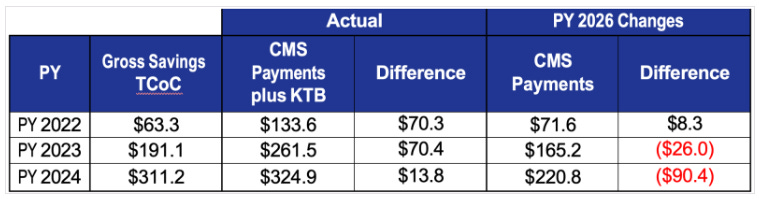
Under the updated rules, and using Wakely’s benchmark-relative methodology, the analysis shows KCC would have generated net savings to CMS of $26 million in PY2023 and $90 million in PY2024, rather than a net cost, with savings climbing further under a full-risk scenario. For context, this analysis differs from Lewin’s earlier evaluation, which used a difference-in-differences design to compare KCC participants against a matched population. The two approaches answer related but different questions: Wakely estimates performance against CMS-set savings targets, while Lewin estimates whether the model changed spending relative to what likely would have happened without it.
Net-net: if Wakely’s analysis holds, a model CMS just made less financially attractive may be performing better than the headline numbers suggest. Wakely argues that this would not be unusual: MSSP took five years to produce net CMS savings, suggesting one- and two-year evaluations may reveal more about a model’s early learning curve than its long-term potential.2 With KCC scheduled to end in 2027, the question now is whether CMS incorporates that approach into whatever comes next.3
Meanwhile, operators are posting strong results. DaVita's Integrated Kidney Care division hit its first profitable year and invested in home health platform Elara. Kidneylink posted the largest cost reduction of any KCC participant, and Interwell Health reported high quality scores and elevated optimal dialysis start rates alongside shared savings of its own. Strive Health's model was featured in a national case study showing a 41% drop in hospitalizations and a 62% rise in home dialysis adoption. Blue Cross NC's Advanced Kidney Care program reduced health care costs by $81.5 million over four years, a sign that payers are building direct kidney VBC capabilities, not just contracting them out. The operating evidence is improving just as the financial incentive to produce those results appears to be shrinking.

And the ground is shifting upstream. Earlier this month, CMS launched ACCESS, a 10-year model paying for patient outcomes rather than service volume, with two of its four tracks built for early-stage cardio-kidney-metabolic conditions (e.g. hypertension, obesity, early CKD). These conditions overlap with the populations kidney VBC operators already manage, but ACCESS is designed to intervene earlier through preventive services tied to specific clinical outcomes and markers. None of the major kidney VBC operators appear on the initial list of accepted participants. A small number of renal practices are participating, but the initial list is dominated by a different mix of organizations, including Withings, WHOOP, Noom, Berry Street, Aledade, AristaMD, Devoted, and Story Health across devices, nutrition, primary care, and chronic-care management.
The model leans heavily on technology-supported care, and the participant list reflects that. With fixed payments as low as $7.50 per patient per month, and commercial insurers pledging to align with the model by 2028, low-cost enabling technologies will need to play a central role if this type of outcomes-based payment model is to prove sustainable.
We track all of this closely. Twice a year, and after every major market move, we publish a sourced, dated log covering policy shifts, company milestones, clinical evidence, and funding activity across kidney value-based care (see below). Our mid-year update just went live, covering the items above and a dozen more.

The full sourced log, along with the dataset we maintain year-round across patient counts, managed spend, financing, leadership changes, and clinical outcomes, is available at vbc.signalsfs.com. If you see a development we missed, or are working through what these changes mean for your strategy, let us know.
The A4H’s Kidney Care Coalition members include DaVita, Interwell Health, Evergreen Nephrology, Strive Health, and U.S. Renal Care.
Bond AM, Civelek Y, Schpero WL, et al. Long-Term Spending of Accountable Care Organizations in the Medicare Shared Savings Program. JAMA. 2025;333(21):1897–1905. doi:10.1001/jama.2025.3870
Wakely’s figures reflect a benchmark-relative calculation (actual payments vs. CMS-set savings targets), which differs from Lewin’s causal evaluation methodology, a difference-in-differences design comparing KCC participants against a matched comparison population using Medicare claims data. The two are not directly comparable; both are cited here for reference to their respective source data.